This was day 2 of the SURF Onderwijsdagen 2025
A new day, a new round, and plenty of opportunities to make 'your move!'. Here’s the recap of day 2 of the SURF Onderwijsdagen.
A musical move
Whereas we ended the first day with the realisation that the next move was up to all of us, at the start of the second day we literally made that move together. Using everyone's smartphones as instruments, we created a veritable symphony, a musical and playful start that loosened our throats and warmed up our laughing muscles.
Then philosopher, writer and columnist Hans Schnitzler took us on a passionate argument about critical digital awareness. In a society where the distinction between true and false is becoming increasingly blurred, he led us, via a modern variant of Plato's rabbit hole, to the moral and social core value of attention. Attention determines what is real; it is, as he aptly put it, the purest form of generosity.
That is precisely why we must learn to protect and consciously give attention. Especially in an era of screenification, re-evaluating our human values is essential. What makes this difficult is that values are what count. The rest, as Schnitzler put it, is simply bullshit.
New energy
Just like yesterday, the plenary session was followed by a tour of the market square for the participants. On day 2, there was clearly more interest in barista coffee than in setting a record on the educational bicycles at the Npuls stand. Which is understandable, given that there are several Npuls sessions on the programme again today, for which energy needs to be gathered. Here are a few highlights:
- Centres for Teaching and Learning (CTLs) as change agents for innovation: In this panel discussion, Nynke Kruiderink (CTL Npuls expert), Ellen Bastiaens (Director of EDLAB, Maastricht University ) and Dorothy Duchatelet (Director of the Centre of Expertise in Education, Open University) discussed how the impact of a CTL can be made visible. Ellen and Dorothy shared how their institutions measure impact and make results visible. An important starting point is that the objectives and responsibilities of a CTL are clearly formulated. This clarity enables the CTL to communicate effectively what it stands for and how it contributes to supporting teachers and the quality of education. Both speakers emphasised that the establishment of CTLs has not only led to stronger cooperation within their own institutions, but also regionally (between universities, universities of applied sciences and vocational colleges) and nationally – for example, within the Launcelot university network. These networks play a key role in building a national knowledge infrastructure. Through knowledge sharing, joint vision development and collaboration, CTLs increase their development capacity, which directly contributes to innovation and quality in further education.
- Communities' turn: During the session, it became clear that a large number of communities are already active both within and outside SURF and Npuls. The participants indicated that it is important to recognise and utilise this diversity in the further development of communities. It was also emphasised that it is important to ensure continuity: how do we ensure that a community remains vibrant and does not come to a standstill after an initial impulse? The group emphasised that communities should not be one-off or non-committal, but sustainable, well-organised and with clear goals. In addition, it was discussed that we are still looking for the right form of communities: which approach best suits the needs of the members? The participants were challenged to think outside the box, which already yielded valuable ideas in the short time available.
- How do you organise AI literacy in education? Certainly not with a chatbot, but through human leadership and collaboration. In the panel discussion in the main hall of Amare, the audience joined in a discussion on how administrators can provide space and support leaders based on content. Patience and teamwork are essential in this regard, as is an eye for the human side. Professional development begins in educational practice, for example with small sessions in which teachers and students discuss AI together, but where a clear link with practice is also established. Inspiring examples from practice promote engagement and understanding. The AI GO framework can help teachers maintain an overview. By actively involving stakeholders, AI literacy remains relevant and connected to the daily reality of education.
To conclude
We ended the second day and with it the 2025 edition of the SURF Onderwijsdagen with a review by Pauline Satter, new member of the SURF Executive Board. This was accompanied by warm applause for all the staff who helped make the Education Days possible.
The writing of this report was slightly delayed due to the writer being temporarily blinded by the keynote speech in which Joost Rigter took us into the world of not being able to perceive with our eyes and where we learned to embrace sensory vulnerability.
Ultimately, connected in our vulnerability and togetherness, it is up to all of us to take action. Let your energy be the impetus for future-proof education.
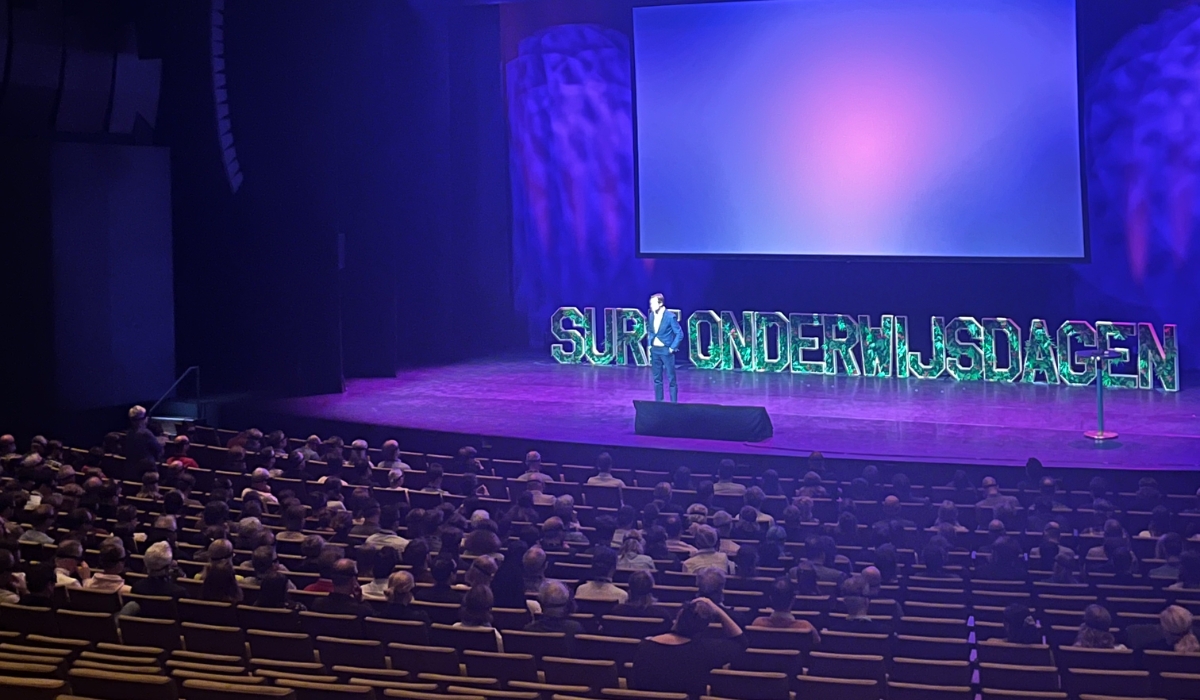
📸 With compliments to the photographer for capturing this image... while blindfolded.